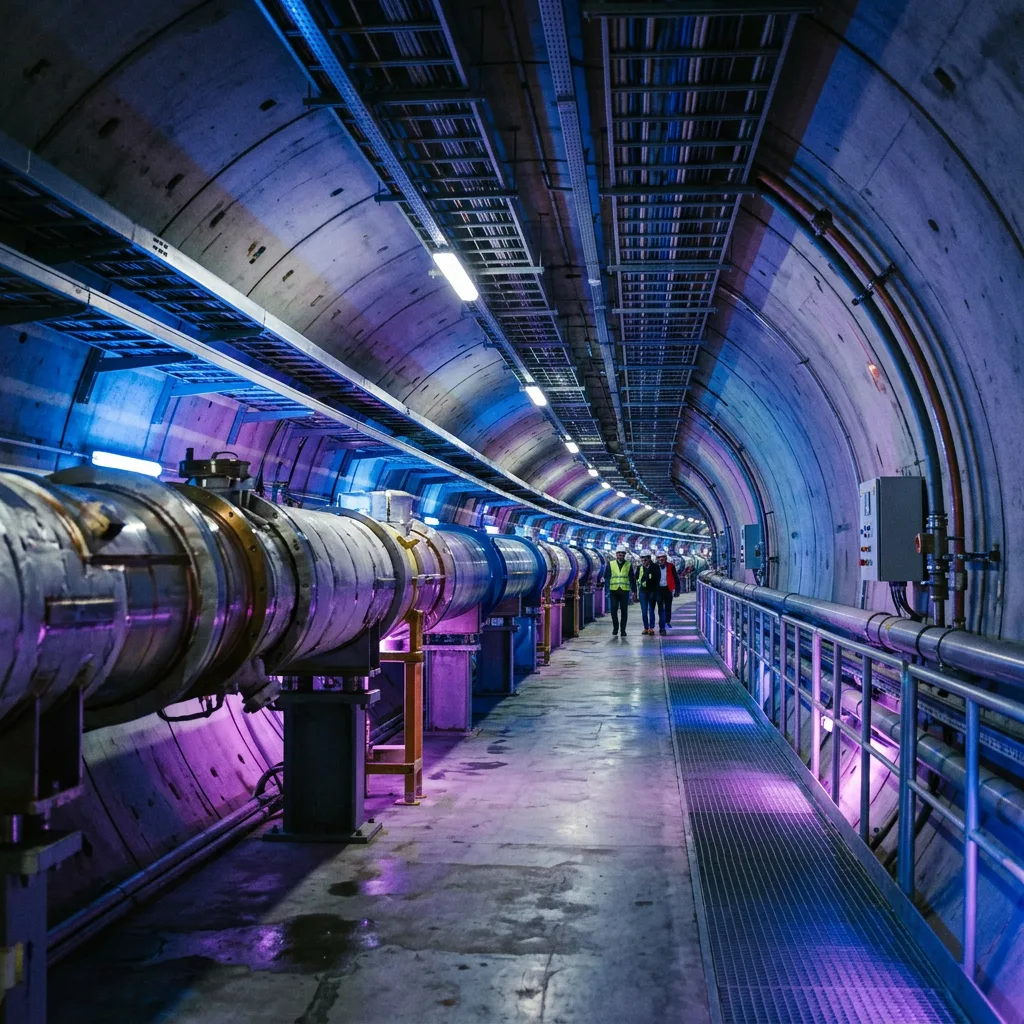
On June 29, 2026, the Large Hadron Collider (LHC) at CERN officially entered a new chapter. After years of groundbreaking physics runs, the world’s most powerful particle accelerator was shut down to begin Long Shutdown 3 (LS3) — a meticulously planned, multi-year upgrade program that will transform it into the High-Luminosity LHC (HiLumi LHC).
This isn’t a mysterious closure or a sudden halt. It’s a scheduled maintenance and enhancement phase following the completion of Run 3, designed to push the frontiers of particle physics even further. Teams are now dismantling about 1.2 kilometers of the 27-kilometer ring, installing new, more powerful magnets, upgrading detectors, and performing extensive consolidation work. The shutdown is expected to last around four years, with gradual restarts anticipated around 2028 and full operations of the upgraded machine targeted for 2030.
The Real Science Behind LS3
The LHC has already delivered extraordinary achievements, most famously the 2012 discovery of the Higgs boson, which confirmed a key piece of the Standard Model of particle physics. HiLumi LHC aims to increase collision rates dramatically — up to 10 times more data — allowing scientists to study rare processes, probe the Higgs particle in greater detail, search for new physics beyond the Standard Model, and explore questions about dark matter, supersymmetry, and the fundamental nature of the universe.
This upgrade represents years of international collaboration, engineering ingenuity, and billions of Swiss francs in investment. It’s particle physics at its most ambitious: not about altering reality, but about better understanding it through controlled, high-precision experiments.
The Mandela Effect: A Psychological Phenomenon, Not a Physics One
Parallel to the very real engineering work at CERN, social media has been buzzing with a familiar narrative: that the LHC shutdown is “reversing” the Mandela Effect, merging timelines, or snapping reality back to some original state. Claims include shifts in classic examples like the spelling of “Berenstain Bears,” the color of Tom Cruise’s shirt in Risky Business, the existence (or non-existence) of a Sinbad genie movie called Shazam, the Fruit of the Loom logo, or even the pose of The Thinker statue. Some report subjective sensations — vivid dreams, déjà vu, or a vague “different” feeling in the world.
The Mandela Effect itself is a well-documented psychological phenomenon. It refers to collective false memories shared by groups of people, often reinforced by suggestion, media, and online communities. Explanations rooted in cognitive science include:
- False memory formation and confabulation.
- Source-monitoring errors (mixing up where a memory came from).
- Social reinforcement and the internet’s echo chambers.
- Expectation bias and the fallibility of human memory.
These effects predate the LHC’s operations and have historical precedents in misremembered cultural details long before 2008. There is no credible scientific mechanism by which LHC collisions — which occur at energies routinely surpassed by natural cosmic rays in Earth’s atmosphere — could alter human memories, history, or macroscopic reality. CERN physicists have repeatedly addressed and debunked such ideas.
Post-Shutdown Claims: Correlation, Not Causation
The surge in “reversal” reports following the June 2026 shutdown is striking but unsurprising in the age of viral social media. Whenever CERN makes headlines — whether starting up, discovering something, or shutting down — waves of speculation follow. However, as one detailed analysis notes, there is no documented evidence of any Mandela Effect actually reversing. No physical artifacts, altered media files, or objective records have emerged; claims rest entirely on personal recollections, which are notoriously unreliable, especially under the influence of expectation and confirmation bias.
Physics doesn’t support timeline merges or portal openings. The LHC creates controlled conditions to observe subatomic particles; it doesn’t rewrite history or consciousness.
Why These Theories Persist
Conspiracy narratives linking CERN to the Mandela Effect thrive because they tap into deep human tendencies: pattern-seeking, wonder at the unknown, and discomfort with how easily our minds can deceive us. The LHC is an awe-inspiring machine operating at scales most people can’t intuitively grasp, making it a perfect canvas for speculation. Online communities amplify anecdotes, turning subjective experiences into “evidence.”
In reality, the extraordinary work at CERN stands on its own merits. The upgrades in LS3 will enable deeper insights into the universe’s building blocks — work that benefits humanity through technological spin-offs, international cooperation, and pure scientific discovery.
As the LHC rests and evolves underground near Geneva, our understanding of reality will advance the old-fashioned way: through rigorous experimentation, peer-reviewed data, and evidence-based reasoning. The Mandela Effect reminds us to stay humble about our memories. The real magic is in the science itself.
What do you think? Have you noticed any “shifts” lately, or are you more fascinated by the actual physics upgrades? Share your thoughts in the comments.